Pages

Tuesday, February 26, 2013

Feb 25-March 1st

Things are getting complicated in science class. Our current chapter is all about mitosis, meiosis, and DNA. There are a lot of new words to learn and mitosis, meiosis I, and meiosis II can be confusing, but I know you guys are fully capable of understanding these important topics!

Monday: Today we finished reading chapter 8 section 2 on Meiosis and Sexual Reproduction. We reviewed mitosis and meiosis and compared these two processes. Remember, mitosis creates two cells that are clones with 46 chromosomes each. Meiosis creates 4 cells that are not clones and each has 23 chromosomes. Homework was to finish the section assessment.

Tuesday: Today we read chapter 8 section 3, DNA. We learned about the differences between RNA and DNA: different sugars, 1 stranded and 2 stranded, different nitrogen bases. We also learned about the 3 types of RNA, mRNA, tRNA, and rRNA and what each of their jobs are. Homework is a review handout.

Wednesday: Today we will finish reading chapter 8 section 3. We will discuss protein synthesis in more detail and learn about the codons that code for the amino acids building blocks of proteins. Homework will be the section assessment and a short handout.

Thursday: Today we will build a model of DNA by folding paper. By making this model of DNA we will gain a deeper understanding of the structure of DNA. Homework will be a review handout.

Friday: Today we are playing Codon Bingo. I will read a 3 base codon, and you will put a bingo marker on the space on your board that has the amino acid represented by the codon. Winners get extra points on the chapter test! Homework is a review handout and to study.

* Review game will be Monday and chapter test will be Tuesday *

Here are some pictures from the last two weeks:

Here we are studying respiration and photosynthesis by placing the water plant Elodea in test tubes with carbonated water and bromothymol blue. Bromothymol blue is yellow green in the presence of an acid. The tubes started out greenish yellow, but the vials that had the green plant and access to sunlight turned clear after a week. Vials that had the green plant but no sunlight turned a darker green because the plant was undergoing respiration, but not photosynthesis. 


To get a better understanding of the organs of excretion, we dissected kidneys from sheep. Students identified the renal veins and arteries, the medulla and cortex of the kidney, and where urine is drained from the kidney. 


Sunday, February 3, 2013

Lessons and HW Feb. 4-8

Reminders: The abstract for your science fair project must be emailed to me by Monday Feb 4th. If I do not forward them to the UNM STEM department, you will not be able to attend regionals. You also need to provide your date of birth in the email with the abstract. Remember to include any changes you have or will be making to your project in the abstract. This abstract must match the final project, or you could be disqualified. In addition, you need to give me a check for $18 made out to Central NM SERC and hand it the media consent forms I gave you on Friday. I will be bringing checks and the media forms to the paper-work drop off at UNM on Wednesday February 6th.

In addition, do NOT forget about your research papers. They are a separate grade from the science project and must be completed. Complete rough drafts are due on Monday Feb. 4. If rough drafts are late, you will lose points. Everybody must write their own paper.

There is a Quest this Friday. STUDY!

This week we will continue to study respiration and excretion in humans and we will finally do what we have all been waiting for... Dissections!! 

Monday: Today we will read section two and take notes and answer questions as we go. This section is on excretion and we will begin to understand how our bodies deal with the waste products of cellular respiration. Homework will be to complete the section 2 assessment and to complete the handout assigned and handed out in class. 

Tuesday: Today we will be in the lab space completing a lab on respiration and photosynthesis and observing the buildup of waste product in respiration when a green water plant is kept in the dark. Yes, we will be using the Elodea sp. sprigs that gave been happily living on the lab bench floating in fresh water. Homework will be to complete any remaining lab questions as well as the review hand-out that will help you prepare for Friday's test. 

Wednesday: In class today we will again travel to the lab Space and we will be dissecting and examining sheep kidneys to learn more about the structure of human kidneys and how excretion is accomplished in mammals. Bring a strong stomach and don't wear your favorite clothes! Homework will be to complete lab questions and to finish a review handout for Fridays test. I suggest that you study for at least an hour this evening to prepare for Thursday's review game. The more you know, the more we can review and the more useful the review will be to you. 

Thursday: Review game. I really hope you studied! Tonight, homework will be to STUDY and complete a review handout that will help you study. Please study for 1 hour tonight. I really want to see improved grades on Friday's test. 

Friday: Test day! Weekend homework is to revise your research papers. They count for a large portion of your grade so work hard on them!


Saturday, January 26, 2013

Field Trip to National Museum of Nuclear Science and History


Whoa! It has been a crazy week! It feels like our field trip on Tuesday was weeks ago rather than days ago. Now that the science fair has happened, and you all performed wonderfully, I have time to reflect on our lovely trip. I would like to again thank Layla's mom and Mahnoor's uncle for helping us drive so that the field trip could happen!

I have to say that I even enjoyed driving back and forth to the museum. The 5th and 6th grade boys rode in my car and it was amusing to hear you guys discussing your video games with so much enthusiasm . When we got to the museum we found seats in a big spacious classroom that had experiments set up on tables around the outside of the room. Of course, all the girls sat at one table and al the boys sat at another (I sat at the girls table).  Our educator was very enthusiastic and had been a teacher for a very long time before she started working at the museum. She introduced us to the concept of nanotechnology by giving us a quiz about what types of nanotechnology had already been developed. Its amazing how much nanotechnology is already being used! Next, we worked on getting a handle on how small a nano really is by measuring our hands in nanometers and then trying to cut a piece of paper as thin as a nanometer (imposible!).

Next we learned that a lot of nonotechnology is constructed out of carbon molecules, in which the carbon atoms come together in hexagons that for little spheres that look like a soccer ball. To help us understand this shape, we folded up a buckey ball. Buckey was the name of the scientist that discovered the structure of this special carbon molecule.


After building these models of carbon molecules, we learned that it is very, very hard to see nano particles. In order to see them, an electron scanning microscope is needed. Instead of looking at nano particles, scientists "feel" them by using special instruments. We modeled this idea by pulling a "nano probe" over a magnet and feeling the bumps. The little bumps represented nano particles and showed us how scientist's feel nano particles.

When the carbon buckey balls are put together to make a tube, they are incredibly strong. To model this concept, we did an experiement with stacking pennies on post-its between two small paper cups. First, the post-its were laid flat and students stacked as many pennies as they could on the paper. Then, the two post-its were rolled up into two small tubes and pennies were stacked on the two tubes. If you could get the balance right, the two tubes were much stronger than the flat pieces of paper.


Then we learned about the importance of surface area by place an alka seltzer tab in water with food coloring and a crushed alka seltzer tab in water with food coloring. The crushed tablet fizzed fatser and for less time because more of the tablet was exposed to the water at once. This is important in so many biological and chemical applications. Surface area is why cells are small!

We also learned about nano technology is sunscreen. Nano particles allow sunscreen to be clear instead of white like the lifeguards in movies with white noses. Inorder to see the effects of sunscreen with nano particles, the girls made bracelets out of UV beans and coated some of the UV beads with sunscreen before heading outside. The beads without sunscreen turned pink, blue, and purple, while the beads with sunscreen stayed white.


Meanwhile, the boys got a handle on how hard it is to pick up nano particles, move them around, and put them together. Two teams were made and one team member would choose lego blocks to hand the builder. The builder wore large oven mitts and had to construct a house of a certain shape and size. It was a lot harder than they thought it would be, but eventually there was success. This showed that it is difficult to work with small materials when you are big, but that it is possible.


After this competition, we moved out into the museum and had our guided tour. We first learned about all the positive uses of radioactivity in medecine. I now know why radiation kills cancer cells, but not regular cells; it targets fast growing cells. This is why it also affects hair follicles and the digestive tract! We observed uses of radiation in everyday life throughout the last century, before people learned that radiation could be harmful to your health. Then we learned about the creation of the atomic bomb, how radioactive material is mined and purified. We learned about the bombs dropped in world war 2 and about the sentiments behind the cold war. We saw fall-out shelters and examples of reading material people had during that time. Next we saw how much nuclear bombs have changed over the years and looked at examples of modern nuclear warheads.

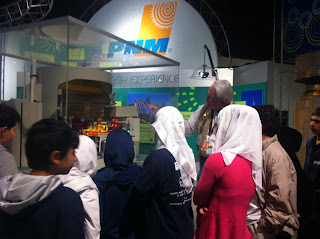


The tour ended outside with all the bombers and missiles that have been retired from use. It was a beautiful day and everybody enjoyed the fresh air. We ran around the yard and looked inside all the airplanes. Next, we headed back inside and played in the Einstein lab. Some of use tried to build up enough air pressure to shoot a ball all the way to the ceiling to ride a stationary bicycle fast enough to power a television. 


We ended our trip by trying to build a nanotube out of carbon molecule building blocks. The teacher told us that non of the visiting classes ever finished the tube, but our tour guide told us that he had finished it. It ended up being a lot harder than it looked. We didn't finish the tube, but we did get it to reach almost over our heads when we communicated and cooperated. Next time we will get it all the way to seven feet tall!


Thank you again for such a wonderful day of learning and playing! I can not wait for our next trip together! :)

Monday, January 14, 2013

Assignments and Announcements Jan 14-18

I am still not used to it being 2013! I feel like I need to write it everywhere in order to get it in my head, so this is was is going on for the week of January 14th, 2013!

Here is a link to the week's (and last week's) packet, in case it is left at school: Chapter 4 Packet

Reminders:
1. There is a test this Friday.
2. Science fair projects (boards and research papers) are due next Wednesday. The fair is next Friday (1/25/2013)

Announcements:
Our first field trip is next Tuesday, January 22nd, 2013. We will be going to the Nuclear Museum to participate in a special program on nano technology and then will enjoy a guided tour of the museum. We will be back at school in time for lunch. The cost of the trip is $7 for students and free for chaperones. We need two parent volunteers to help drive and chaperone. Please email me is you are interested!

Monday: 
Today in class we started two experiments. We placed pineapple chunks on prepared gelatin in plastic containers and allowed the pineapple to sit overnight. We will observe the gelatin tomorrow to see what effect the pineapple had. We also measured the masses of two de-shelled eggs (I removed the shells by dissolving them in vinegar over the weekend; it was the first time I dissolved egg shells and it was really fun and cool: see picture). We then placed the de-shelled eggs in distilled water. We will measure the mass of the eggs again on Wednesday to see if water diffused into the eggs (osmosis). We will then submerge the eggs in corn syrup and measure the mass again on Friday to see if water diffused out of the eggs (osmosis, again!). There is a handout for homework today. 


Tuesday:
We will start class by observing our two experiments set up yesterday. 
Today we will read the last section (sect. 3) of our chapter on cellular processes. Homework will be to complete the section 3 assessment and there will be a short handout to help review for Friday's test. 

Wednesday: 
We will take the masses of our eggs and transfer the eggs into corn syrup solution.
We will also do a short activity observing diffusion in cold and hot water. 
Finally, we will work on the the chapter review section at the end of the chapter and fill the answers in in the space provided in the packet. Homework will be to finish the questions we did not do in class and a handout.

Thursday: 
We will review material for the test. Come prepared with questions you might need to ask after having worked on the chapter review assignment in the text. Homework will be to STUDY! Use your vocabulary foldable, the packet, the summary at the end of the text chapter. I will also hand out a chapter review worksheet. Use it to study, it is also homework. 

Friday:
Test Day!!!
Packets and permission slips are due.
Weekend homework is to work really, really hard on your science fair project! Make it something you will be proud of! Do good work!

Saturday, January 5, 2013

Hey Girls!

On January 26th, there is a free science, technology, engineering, and math (STEM) event at UNM for girls grades 5-9. Students from Salam academy have attended in previous years and have reported that it is a fun and educational event with free goodies and really interesting projects, activities, and scientists to meet! I will be attending the teacher workshop, so I will see you there!

Here is the link to the official website and online registration:
Expanding Your Horizons Albuquerque Conference

Check out this video that shows you some of the amazing activities you may participate in! There may be veterinarians, marine biologists, doctors, forensic scientists, or astronauts available to teach you and show you what they do in their career!


In addition, girls who attend will receive one free homework assignment!!!!

Thursday, December 27, 2012

IMPRT Break Assignments!

Hey Kids!

I wanted to get this information to you earlier, but traveling and holiday activities have kept me quite busy. Here's the low-down on science fair: If you have approval on your project (everyone except Mahmmud and Odey) and you are allowed to do it at home (everyone except Layla), you should be experimenting all break! Remember to record data in data tables in your LAB NOTEBOOK; write down the date and time everytime you work on the project and write down EXACTLY what you do. Have the data tables drawn before you write in the data. Make sure that experiments are done more than once. Results MUST be repeatable.

In addition to experimenting, you will write two sections of your research paper: the introduction and the methods. The intrpduction is the "research" part of the paper. You will have to read about your topic and learn as much as you can. Then, write a 2 page esay "introducing" your topic, which should include the history of the topic, general background knowledge and informatiion, and a description of why your specific project is interesting, why other people should care about your project, and how your project will help people or advance science. Your methods section is like a procedure, but is written in paragraphs instead of as a list. The methods are written in the past tense, since you should have done the experiment already. It should sound like this: "one hundred mL of water was added to 50mL of olive oil and allowed to settle. Two drops of food coloring were dropped into the oil/water mixture and was observed for two minutes. Observations were recorded every 30 seconds for the 2 minute period." If you use sources that were not on your original References list, please make a new reference list. The introduction and methods sections will be typed in 12pt font and double spaced and printed so that I can mark it.

On the fist day after break I will collect your introduction, methods, and your lab notebook. I will grade these three things and they will count as a separate "project grade" and will therefore have a large effect on your overall grade. Please work very hard on this assignment and take it seriously!
I'd love to see Salam Academy send students to States again this year! And, I know you would love to have sonme extra cash and glory :)

Mrs. Brisbin

Tuesday, December 18, 2012

Lessons and HW Dec. 17-21

Hey Y'all!
Hooray for Quests and Vacation! This week we will finish chapter 6 and have a Quest on Thursday. Do not miss school! Friday will be important, too. Vacation starts on Saturday!

Monday:
Today we went to the lab space to observe cells. Bilal, Mahmmud, and Sannan got their turn at the microscope and looked and corn root cells and human motor neurons! Isa finally took the chapter 1 test, and everyone else got a headstart on the homework coloring packet, "Cells and their Organelles."

Tuesday:
We will start a lab experiment in the classroom today. The observations will be made on Friday (one of the reasons Friday's class is so important!). This lab will exemplify the scientific method, but is also related to what we are learning and what we will be learning after break as it will involve bacteria. After we set up the lab (should take 20 minutes), we will start reviewing in our textbook together. We will begin the chapter review in the text. Homework will bea  review worksheet handed out in class and the section 3 assessment questions (write your answers in your packet).

Wednesday:
In class, we will finish the review section from the textbook. As we do this we will discuss any questions that arise. If you are confused about anything in chapter 3, now is the time to bring it up!
Homework is to STUDY!! Remember, if you did not score well on the first test, you already used your "freebie." Make this test a good one!!

Thursday:
Quest day :)
I hope you studied ;)

Friday:
We will observe the results of our first bacteria lab. Lab questions will be completed in class and the lab page will be due this day. Please, do not skip school!

Break work will mostly involve the science fair and more information will be given to you soon!